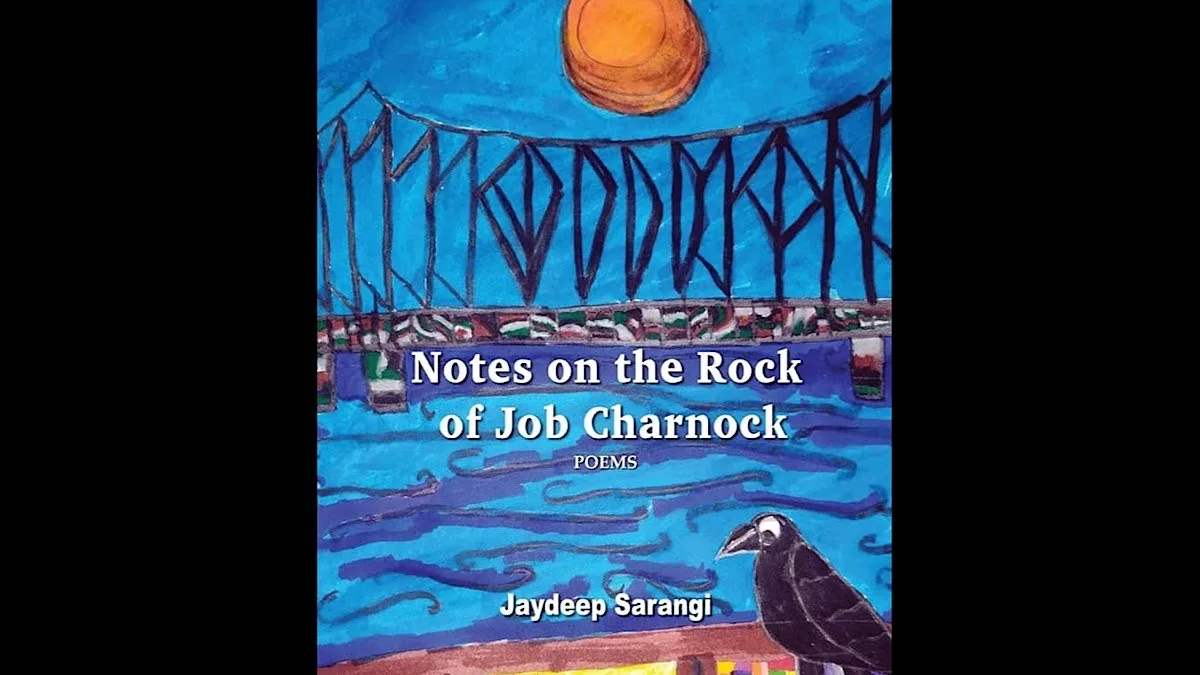
Jaydeep Saranagi is an academic and a creative writer based in Kolkata. Notes on the Rock of Job Charnock is his latest collection of poetry. This slim volume (88 pages) is thematically anchored in Kolkata, marked by a deep investment in marginal histories, memory, and spatial-cultural consciousness. No tes on the Ro ck of Job Charnockspeaks of Kolkata’s layered past, and its affective geography, especially the riverine life-world of the Ganges. The volume engages deeply with the symbolic presence of Job Charnock, traditionally associated with the colonial origins of the city.
In “Myth of a City” Sarangi writes, “from the shadows I heard/ of land and river, how myths /are formed and inherited, /in my city of joy and sorrow /as an aside, slum’s eye view /at times dumb, flowing/even for now, serving”.The aesthetic cover art by Parthsarathi Sahu immediately catches attention, makes the readers curious and is closely connected with the identity of the volume. The title Notes on the Rock of Job Charnockis interesting and intriguing—“Rock” evokes Charnock’s tomb (built of charnockite stone), signifying the colonial inscription of perpetuity upon Indian soil.
Advertisement
By calling the poems “notes,” Sarangi subverts authoritative history, suggesting fragmentary, subjective engagements rather than grand narratives, allowing multiple voices and temporalities tocoexist. Heoffers a poetic re-reading of Kolkata’s past, shifting focus from imperial authority to lived, affective experience.This is particularly resonant given that modern historiography questions Charnock’s status as the city’s founder.The poet contends,“You would chuckle, what’s in a name? /With Calcutta already grown in parts/Idle but prosperous in a native style, / shining with terracotta artifacts, pottery.” (“On his Rock”). The Ganges River appears as a central metaphor—both a physical presence and a spiritual continuum.
Kolkata emerges as a palimpsest where colonial residues and contemporary life intersect.“I got a river, the ancestors’ eyes,/the cave of living among my city of poems” (“Doors of Paper for my Muse”).The poems in the volume concentrateon personal memory over official historical discourse, aligning with postcolonial literary practices. Mapping the emotional geography of an iconic city and bridging local experience with global readerships, Sarangi’s work contributes to contemporary Indian English poetry by reinterpreting colonial history through lyrical subjectivity. “My metaphors rained over you, Kalikata to Kolkata / love’s bag has no summer. /Stroking your back, /only walking with memories and shadows of faith. /Let me come to be still in your family frame” (“Kalikata”).
By intertwining history, memory, and place, Sarangi offers a nuanced poetic discourse that resonates beyond national boundaries, “in this body’s city /floating, feathers flapping /where I can disappear softly / with a white paper in a loveless monsoon /in the company of vanishing birds /near a lily pond wrapped in mist /streaming with old stories and shells /Residencia en la tierra”.Sarangi has evolved his own voice within English, reshaping the language to reflect local realities rather than reproducing colonial idioms. Notes on the Rock of Job Charnock is a noteworthy addition to the shelf of English poetry from the City of Joy.
(THE WRITER IS AN ASSOCIATE PROF AND HOD, DEPARTMENT OF ENGLISH. TARAKESWAR DEGREE COLLEGE, THE UNIVERSITY OF BURDWAN. VIEWS EXPRESSED ARE PERSONAL)